Link copied!
Regulation
YouTube opens Masthead ads to iGaming operators, but affiliates stay locked out

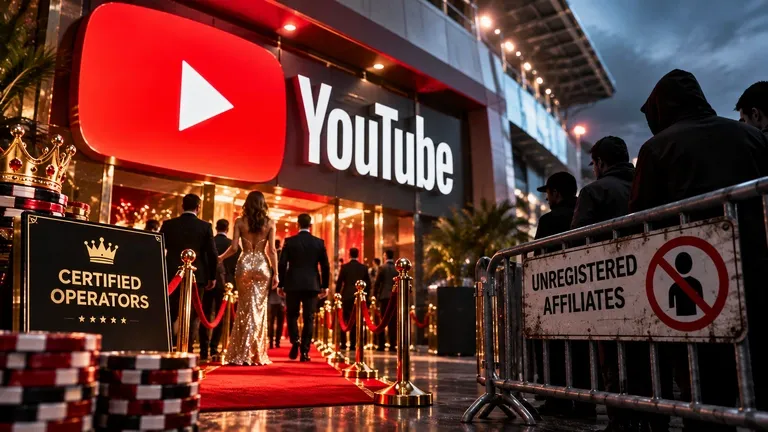
YouTube will open its Masthead placement to certified online gambling advertisers starting October 21, ending a four-year restriction that limited the slot to sports betting, but the policy’s exclusion clause keeps affiliates and aggregator sites shut out regardless.
A second crack in a wall built in 2021
Starting October 21, YouTube will open its Masthead placement, the reserved ad slot at the top of the platform’s homepage and Home feed, to certified online gambling advertisers for the first time since the category was banned there in 2021. Google’s own advertising policy page frames the update as “expanding upon the platform’s existing allowance for sports betting,” which has been the only gambling vertical permitted on Masthead since September 2022. The notice went up on October 7, giving the industry the standard 14-day runway Google uses for ad policy changes before they take effect.
Masthead isn’t an auction slot the way most YouTube ad inventory is, it’s reserved, premium placement that autoplays silently for up to 30 seconds on desktop and for its full length on mobile, sitting directly at the top of the page every visitor sees first. The scale behind that visibility is substantial: YouTube pulled in $10.3 billion in ad revenue in a single quarter as recently as Q3 2025, and Masthead sits among its highest-value formats specifically because it guarantees reach rather than competing for it. When Google rolled out Masthead content rules in June 2021, gambling was grouped with elections, alcohol, and prescription drugs under a blanket prohibition that held for roughly 14 months. September 2022 brought the first crack in that wall, letting sports betting in along with daily fantasy sports for Canada, India, and the United States specifically. October 21, 2026 is the second crack, and a considerably wider one: it covers online gambling as a category rather than carving out one more narrow exception.
Certification is per-country, not a single global pass
Getting there requires more than checking a box. Advertisers need certification under Google’s Gambling and Games policy, and that certification isn’t a single global approval, operators have reported needing separate applications per target country, with recertification triggered by material changes to their product or business. Beyond certification, every campaign still has to clear each market’s own licensing requirements, age-verification rules, and geographic targeting restrictions, meaning approval to run Masthead ads in one country establishes nothing about eligibility in the next one. Google’s notice doesn’t name which markets are actually in scope for the October 21 change, and it leaves open whether a Masthead-specific certification layer exists on top of the general gambling certification, or whether social casino games and daily fantasy sports inherit the same expanded access automatically.
The exclusion that matters most to affiliates
The detail that matters most for anyone working the affiliate side of this industry sits in a single excluding clause: the new allowance explicitly does not cover “advertisers of online-gambling promoting content who are not subject to mandatory state or national gambling registration requirements.” In plain terms, that’s affiliates and aggregator sites, the entities that promote licensed operators without being licensed operators themselves. Being eligible to run standard Google Ads campaigns as an affiliate doesn’t carry over to Masthead access, because the exclusion is built around who’s directly regulated as a gambling business, not who’s allowed to advertise gambling-adjacent content elsewhere on Google. For operators, October 21 opens one of YouTube’s most valuable placements to a vertical that’s been locked out of it for four years. For the affiliates driving traffic to those same operators, nothing changes at all, Masthead stays exactly as closed to them as it was the day before.
“
“Operators get the most expensive seat in the room, affiliates still don’t even get let into the building, and that gap is the whole story here.”

Related tags





Share
SUBSCRIBE TO OUR PRIVATE CASES AND USEFUL TIPS
Subscribe to our newsletter, get only exclusive content and weekly digests, no any spam!
By providing my email, I accept the Privacy Policy.