Link copied!
Regulation
US offshore iGaming hits $97.4 billion, growing twice as fast as licensed market

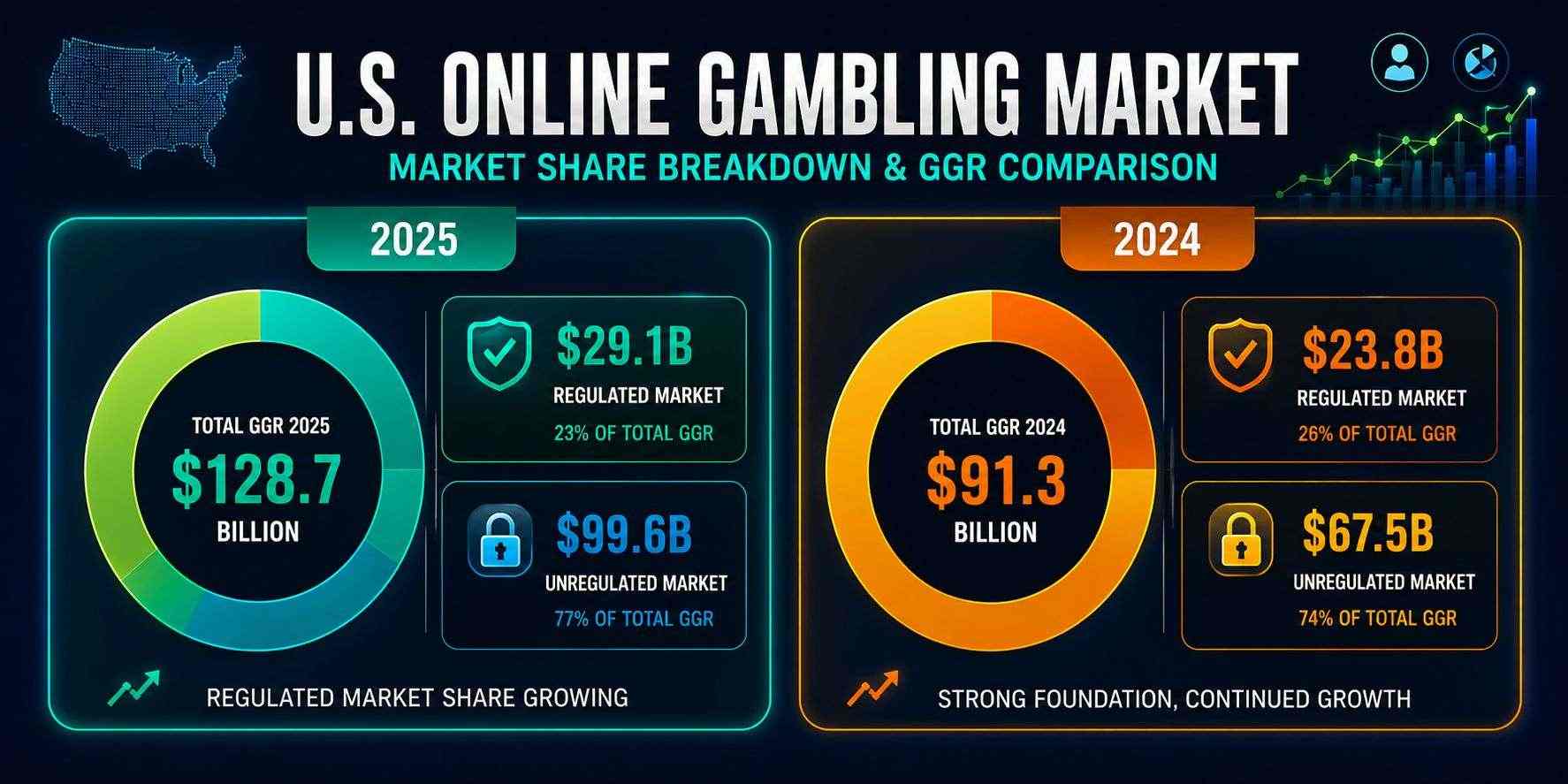
Unregulated iGaming pulled in $97.4 billion from US consumers in 2025 — a segment growing nearly twice as fast as the licensed market it competes with, according to a new report from Gaming Compliance International (GCI).
How big the US offshore iGaming gap has grown
The core imbalance shows up in the growth rates as much as the totals: unregulated operators grew 45.2 percent this year, nearly double the 23 percent licensed operators managed. That gap pushed the market’s overall composition further from regulated territory, even as the whole US iGaming market — legal and illegal combined — expanded from $90.1 billion to $125.6 billion, a 39.4 percent increase.
Broken into dollar figures, unregulated activity accounted for $97.4 billion in 2025 versus $67.1 billion the year before; licensed platforms brought in $28.3 billion, up from $23 billion. Unregulated operators now hold 77 percent of the market, up from 74 percent, across a scope covering online sports betting, casino games, poker, and prediction markets — the last classified as a financial derivative instead of gambling under current US law.
Why the AGA’s estimate is so much lower
The American Gaming Association, representing licensed US operators, puts the total illegal market at just $53.9 billion, built from a different method: a survey of 2,454 adults plus a direct count of unregulated skill-game terminals. Terminals alone accounted for $30.3 billion, with online illegal iGaming at $18.6 billion and illegal sports betting at $5 billion — the categories comparable to GCI’s online-only numbers — and even those combined, $23.6 billion, land nowhere near GCI’s $97.4 billion.
The methodologies explain most of the gap. GCI builds its estimate through keyword sweeps that locate gambling destinations reaching a jurisdiction, then applies machine learning to price that traffic against known legal-market benchmarks, built for a market too fragmented to survey directly. Derek Webb, who commissioned the report through his Campaign for Fairer Gambling, put the logic bluntly: “criminals do not file returns,” which is why survey-based methods tend to undercount activity designed to stay invisible.
GCI’s own numbers haven’t gone unchallenged. When the firm estimated global crypto-gambling revenue at $81.4 billion, blockchain analytics firm Tanzanite independently tracked over 90 wallet addresses and came back with a figure just above $10 billion — a gap wide enough to question how much weight GCI’s extrapolation-heavy methodology can bear.
“
Whichever number you trust, both major estimates agree on the direction: the unlicensed side of the US market is growing faster than the regulated one, and neither the AGA’s nor GCI’s methodology was built to capture the other’s blind spots.

Related tags





Share
SUBSCRIBE TO OUR PRIVATE CASES AND USEFUL TIPS
Subscribe to our newsletter, get only exclusive content and weekly digests, no any spam!
By providing my email, I accept the Privacy Policy.