Link copied!
Vertical basics
Slot RTP and volatility explained: what affiliates need to know before picking which titles to push

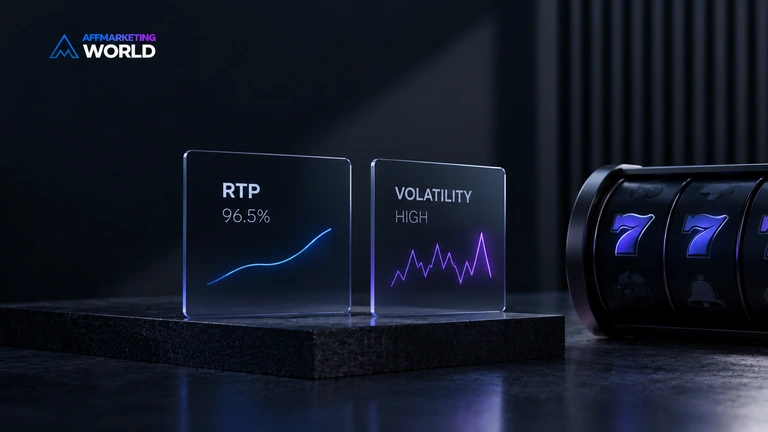
Every slot has two numbers quietly shaping how it performs for players, and by extension, how it performs for whoever is sending traffic to it: RTP and volatility. Most affiliates can recite "RTP = return to player" without being able to explain why two slots with the identical 96% RTP can feel nothing alike — and that gap matters when you’re choosing which title to build a landing page or creative around.
This is the explainer written for the person picking the offer, not the person spinning the reels.
RTP: what it actually measures
RTP (Return to Player) is a theoretical long-run average, calculated over millions of simulated spins, not a promise about any individual session. A 96% RTP slot is mathematically designed to pay back $96 of every $100 wagered across its entire lifetime of play — which tells you almost nothing about whether a specific player walks away up or down tonight.
RTP is typically set by the game provider (Pragmatic Play, NetEnt, Hacksaw, etc.), not the individual casino, though some providers do offer multiple RTP configurations of the same title and let operators choose which one to run. That means the number isn’t always universally identical across every casino — worth checking if you’re promoting a specific title across multiple programs.
94-97%
Typical RTP range for mainstream online slots
3
Common volatility tiers — low, medium, high
1M+
Spins typically simulated to calculate a stated RTP
Volatility: the number that actually shapes the experience
Volatility (sometimes called variance) describes how wins are distributed over time, independent of RTP. A low-volatility slot pays small wins frequently, keeping the balance relatively stable session to session. A high-volatility slot pays rarely, but the wins that do land can be dramatically larger — long dry stretches broken by the occasional big hit.
Two slots can carry the exact same 96% RTP and feel like completely different products: one feels "generous" because of frequent small wins, the other feels "stingy" right up until a single spin pays out 500x the stake. For a player, that’s a matter of taste. For an affiliate, it’s a matter of which creative angle and which traffic source actually fits the product.
| Volatility | Player experience | Traffic angle that fits |
|---|---|---|
| Low | Frequent small wins, stable balance, longer sessions | Retention-focused, steady traffic — content sites, SEO, email |
| Medium | Balanced mix of regular wins and occasional bigger hits | General-purpose traffic — most paid social and display |
| High | Long dry spells, rare but large payouts | Big-win hype — native ads, Telegram funnels, streamer clips |
Why this matters for which traffic converts
RTP mostly affects how long a deposited balance lasts, which feeds into session length and the odds of a repeat visit — relevant to RevShare affiliates who get paid on ongoing player activity rather than a single signup. Volatility affects something more immediate: the emotional hook that makes a creative or a landing page actually convert a cold click into a deposit.
A high-volatility slot’s "I just hit 500x on a $1 spin" screenshot is the kind of content that travels on native ads and Telegram channels precisely because it promises a dream, not a grind. A low-volatility slot doesn’t generate that kind of shareable moment, but it’s a better fit for content built around "reliable, steady entertainment" — a different pitch, for a different kind of visitor.
Provider matters as much as the individual title
Game providers negotiate exclusive or early-access deals with specific operators, and some providers simply test better on certain GEOs or traffic types. If a casino affiliate program is pushing a specific provider hard, that is often a signal the provider’s titles are already converting well on that program’s own traffic data — worth asking an affiliate manager directly rather than guessing.
Hit frequency: the third number nobody mentions
RTP and volatility get all the attention, but hit frequency — how often a spin returns any win at all, regardless of size — is the number that most directly shapes the moment-to-moment feel of play. A slot can be high-volatility with a relatively high hit frequency (frequent small wins punctuated by rare huge ones) or high-volatility with a low hit frequency (long silence, then one enormous payout). Two "high volatility" slots described identically in marketing copy can play completely differently because of this third, rarely-published figure.
Hit frequency isn’t always disclosed by providers the way RTP is, which means it’s often something you only learn by watching real session data or asking a network that tracks performance by title. Where it’s available, it’s worth factoring in — a player who sees zero wins for 80 spins in a row churns out of a session a lot faster than the volatility number alone would suggest.
How to verify claims instead of trusting marketing copy
Provider marketing pages round numbers and lean on whichever stat flatters the title, so treat a headline RTP or "high volatility" label as a starting point, not a verified fact. A few affiliates-only ways to check: ask your network’s affiliate manager for conversion and retention data broken down by provider or title, since that reflects what actually happens on real traffic rather than a lab simulation; cross-reference the RTP listed by the provider directly (not the casino’s own marketing page, which can lag or simplify); and watch for a specific casino running a lower-RTP configuration of a title than the one most commonly cited online.
None of this needs to turn into a research project before every campaign — but for a title you plan to build a dedicated landing page or recurring creative around, the ten minutes it takes to confirm the real numbers is cheap insurance against building a funnel around a stat that doesn’t match what your traffic actually experiences.
- Match volatility to your traffic source. High-volatility titles for hype-driven channels, low-volatility for content and retention traffic.
- Don’t assume RTP is identical everywhere. Check whether the casino you’re promoting runs the same RTP configuration as the one you researched.
- Ask about provider performance data. An affiliate manager who tracks conversion by provider can save you weeks of blind testing.
- Pick the angle before the title. Decide whether you’re selling "big win potential" or "steady entertainment" first, then find a slot that actually matches that promise.
- Remember RTP is a long-run average. Neither number predicts any single session — don’t build landing-page copy that implies otherwise.
“
RTP tells you what a slot pays back over a million spins. Volatility tells you what it feels like on the one spin a new visitor actually plays. Affiliates who only look at the first number are optimizing for a statistic nobody in their funnel will ever personally experience.

Frequently asked questions
1
What is RTP in slots, in simple terms?
RTP (Return to Player) is the theoretical percentage of all wagered money a slot pays back to players over millions of spins — a 96% RTP slot returns $96 for every $100 wagered, on average, over the long run. It says nothing about what happens in any single session, including yours.
2
What is volatility (or variance) in a slot?
Volatility describes how wins are distributed, not how much is paid out overall. Low volatility means frequent, small wins; high volatility means long dry spells broken by rare, large payouts. Two slots can share the same RTP and feel completely different to play.
3
Does higher RTP mean a slot converts better for affiliate traffic?
Not directly. RTP affects how long a player's balance lasts, which affects session length and repeat visits — but volatility affects the emotional experience that drives screenshots, shares, and word-of-mouth, which often matters more for acquisition than the RTP number itself.
4
Why do some casino affiliate programs push specific slot providers?
Providers negotiate exclusive or early-access deals with specific operators, and some providers test better for specific GEOs or traffic types. An affiliate program promoting a provider heavily is often signaling that the provider's titles are converting well on that program's own traffic data.
5
Is RTP the same on every casino for the same slot?
Usually yes for the base game, since RTP is typically set by the game provider, not the casino. But some providers offer multiple RTP configurations for the same title, and individual casinos can choose which configuration to run — so it is not universally guaranteed to be identical everywhere.
6
How does volatility affect which traffic sources work for a slot offer?
High-volatility slots pair well with traffic that responds to big-win hype — native ads, Telegram funnels, streamer content — because the appeal is the dream of a massive hit. Low-volatility slots suit steadier, retention-focused traffic where players expect to grind small wins over longer sessions.
See gambling affiliate programs ranked by real payout terms
Compare casino affiliate programs with verified commission models, GEO coverage, and payout data.
Related tags


Sponsored
Share
SUBSCRIBE TO OUR PRIVATE CASES AND USEFUL TIPS
Subscribe to our newsletter, get only exclusive content and weekly digests, no any spam!
By providing my email, I accept the Privacy Policy.