Link copied!
AI
Skales is a free, local-first AI agent that runs on your desktop instead of the cloud

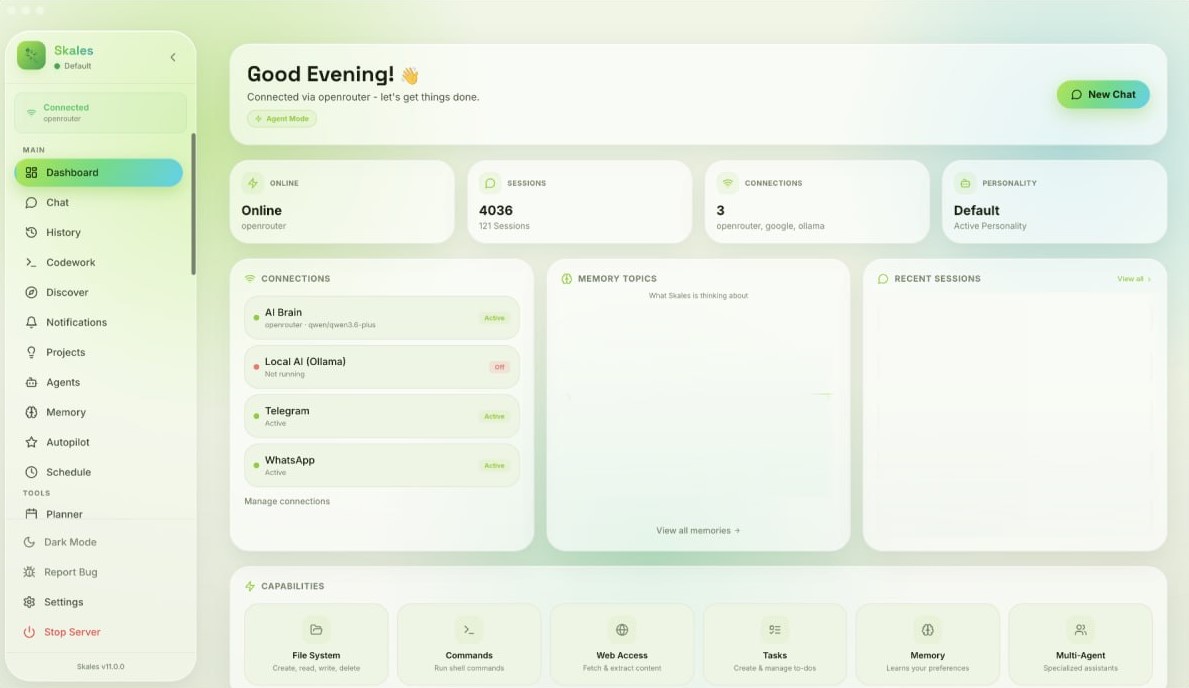
A solo developer in Vienna has built Skales, a free desktop AI agent that runs entirely on your own machine and can act on your browser, email, calendar, and files without sending anything through a cloud middleman.
What it does
You install it the same way you’d install any other program — drag it into Applications on a Mac, run the installer on Windows — and you’re done in about half a minute. Give it a goal (the project’s own example: “/goal build me a trading bot”) and it keeps running in the background: a task you set today is still active when you check back tomorrow, even after quitting and relaunching the app in between. You can also point it at something recurring — checking a price on a fixed schedule, down to the minute, the same way you’d set up a job on a server — and it’ll keep running unattended for as long as you need.
A mobile app for Android and iOS pairs with the desktop install, letting commands get sent from a phone while the actual work runs on the PC. The whole project is open source, and anyone curious can pull the code directly from GitHub.
Under the hood
That local-first design is the more unusual part of the pitch. Most AI agent tools launching this year route everything through a company’s own servers by default; Skales stores conversations, memories, and files on your machine, with cloud providers available only when you actively add an API key.
The agent connects to more than 15 AI providers under a bring-your-own-key model — everything from OpenAI, Anthropic, and Google to fully local options like Ollama and LM Studio — so nothing has to touch Skales’ own infrastructure unless you choose to. A built-in free tier called Skales IQ works without any API key at all, which is likely where the “runs fine on modest hardware” reputation comes from, since it doesn’t force a heavy local model onto every install.
Memory carries over between sessions, with an overnight process the project describes as three-phase “dreaming” that consolidates what it’s learned. Personal projects, coursework, and internal business use all cost nothing under the current license — that free-use window holds until April 2030, at which point the code converts to the fully open Apache 2.0 license.
Twenty-plus contributors, 200 forks, and 1,500-plus stars — solid traction for a project one person in Vienna is still building alone.
“
The BSL license here is worth watching closely. “Free forever” for personal and educational use is generous, but internal business use sitting under the same non-commercial-adjacent license as the underlying model is the kind of clause that tends to get renegotiated once a project this size starts attracting real commercial interest before 2030 rolls around.

Related tags



Share
SUBSCRIBE TO OUR PRIVATE CASES AND USEFUL TIPS
Subscribe to our newsletter, get only exclusive content and weekly digests, no any spam!
By providing my email, I accept the Privacy Policy.