Link copied!
AI
Revolut cut AI coding costs 90% by self-hosting GLM for 2,000 engineers, not by switching providers

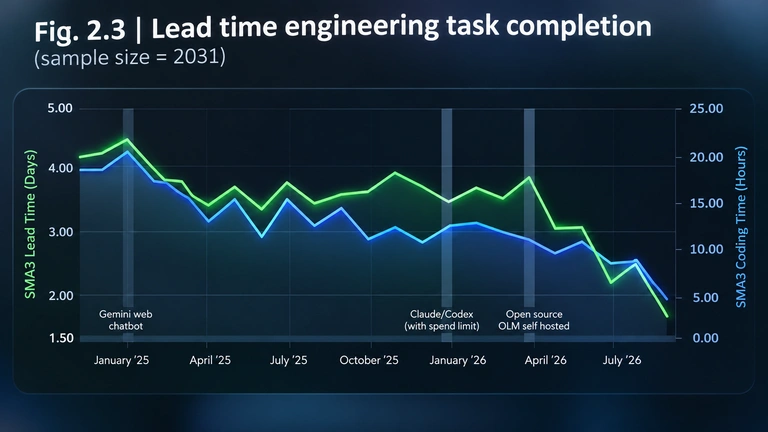
Revolut says it cut its AI coding costs by roughly 90% after moving about 2,000 engineers off metered Claude Code and Codex usage and onto GLM 4.5, the open-weight model from Chinese lab Z.ai, according to Trending Topics. The headline number is real, but the framing matters: this wasn’t a simple provider swap to a cheaper API.
It’s self-hosted, not a cheaper subscription
Revolut self-hosts GLM 4.5 on its own infrastructure, running it across 56 Nvidia B200 GPUs, with the OpenAI-compatible setup plugging into tools like OpenCode and Codex. Image-generation tasks still get routed to Gemini or similar models elsewhere, so the self-hosted path covers text and coding work specifically. The effective cost per million tokens comes out to about $0.30, roughly a tenth of what Revolut had been paying Anthropic and OpenAI for the same workloads, and that comparison is what produces the 90% figure. That math excludes cloud infrastructure, staffing, and observability costs tied to running the self-hosted setup, and getting there took real engineering work rather than a flip of a switch: Revolut’s team has said out-of-the-box inference performance was poor, and raised throughput 88% while demand grew 76% without adding GPUs, through tuning context limits, quantization, and parallelism settings specific to GLM’s architecture.
Faster code, and fewer rationed tokens
On the productivity side, Revolut reports coding time falling about 60% and lead time, the span from picking up a task to merging it, falling about 70% across the roughly 2,000-engineer sample after the switch. Time to first token dropped from more than 10 seconds to 1.6 seconds, and the system now handles more than 7 requests per second, up from 3 before the retuning. Removing hard token limits appears to be a real driver behind some of that lead-time improvement specifically, since engineers no longer had to ration usage and reportedly started automating smaller non-coding tasks, like inbox triage, that they’d previously just done by hand.
A result built for Revolut’s scale, not anyone’s
The catch is that this result assumes a company with 56 B200 GPUs sitting idle to dedicate, an engineering team capable of the tuning work involved, and enough scale to justify building the infrastructure in the first place. A smaller team trying to replicate Revolut’s numbers by simply pointing their agents at a hosted GLM API, without the self-hosting and tuning behind it, would likely see a smaller gap between the old and new costs.
“
“A 90% cost cut sounds like switching subscriptions, but what Revolut actually built was its own inference stack, tuned by people who know exactly how many GPUs they have to spare.”

Related tags






Share
SUBSCRIBE TO OUR PRIVATE CASES AND USEFUL TIPS
Subscribe to our newsletter, get only exclusive content and weekly digests, no any spam!
By providing my email, I accept the Privacy Policy.