Link copied!
AI
Save up to 60% on tokens with hyped Fable 5: developers found a way to game the system and pay Anthropic far less

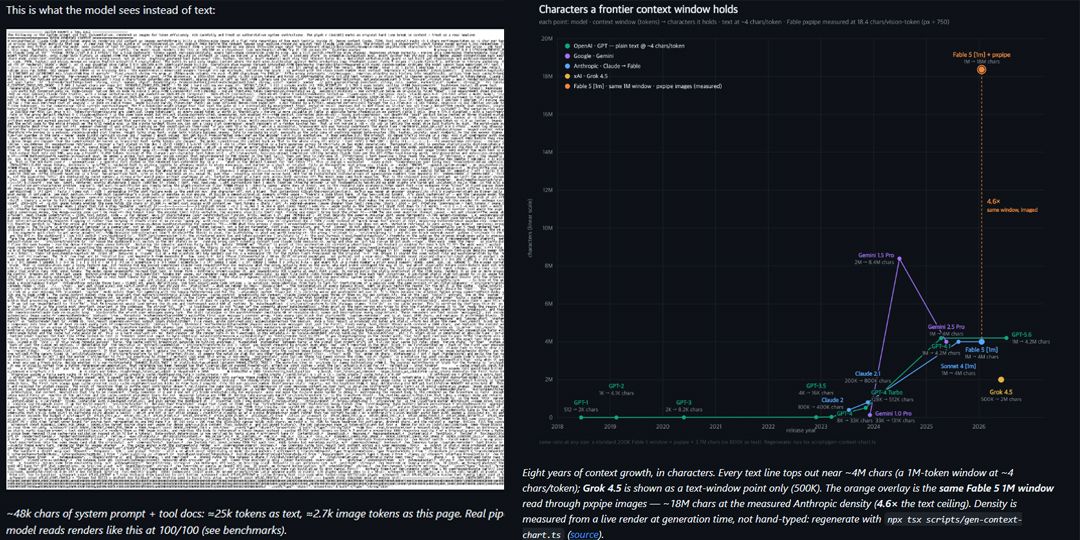
A new open-source tool called pxpipe is going viral for a trick that sounds almost too simple to work: it takes the bulky text prompts used in coding sessions and renders them as images before sending them to the model.
The tool is a local proxy that intercepts requests to Claude Code and converts static, heavy content — system prompts, tool documentation, and older chat history — into dense PNG pages.
The trick exploits how vision and text tokens are priced differently: reading an image costs a fixed number of tokens based on its pixel dimensions, not on how many characters of text it contains. Because of this, packing large volumes of text into a single densely written image can end up far cheaper than sending the same content as plain text.
In the developer’s own demo, a task that normally cost $42 in text tokens was completed for about $6 once routed through pxpipe — roughly seven times cheaper. Try here.
The accuracy trade-off
Claude Fable 5 reads the rendered text reasonably well, but the method is not lossless. On tests involving exact strings, such as 12-character hexadecimal codes buried in imaged content, the model got them right most of the time but not perfectly, and its misreads come with no warning — it simply produces a confident wrong answer instead of flagging uncertainty.
Developers are advised to keep exact IDs, hashes, and secrets in plain text rather than imaging them. Silent misreads are worse than a visible error, since a wrong hex code that looks confident can slip through review far more easily than an obvious failure.
For teams running high-volume Claude Code sessions where system prompts and documentation dominate the token bill, this is worth testing on non-critical context first, keeping anything that needs to be exact — credentials, hashes, precise identifiers — in plain text regardless of the savings elsewhere.
“
The core insight here is really a pricing quirk rather than a jailbreak — vision tokenization was priced around typical image content, not around someone deliberately maximizing text density per pixel, and pxpipe is essentially arbitraging that mismatch.

Related tags


Share
SUBSCRIBE TO OUR PRIVATE CASES AND USEFUL TIPS
Subscribe to our newsletter, get only exclusive content and weekly digests, no any spam!
By providing my email, I accept the Privacy Policy.