Link copied!
Traffic format guide
Push vs Popunder vs Native: which traffic format fits which vertical

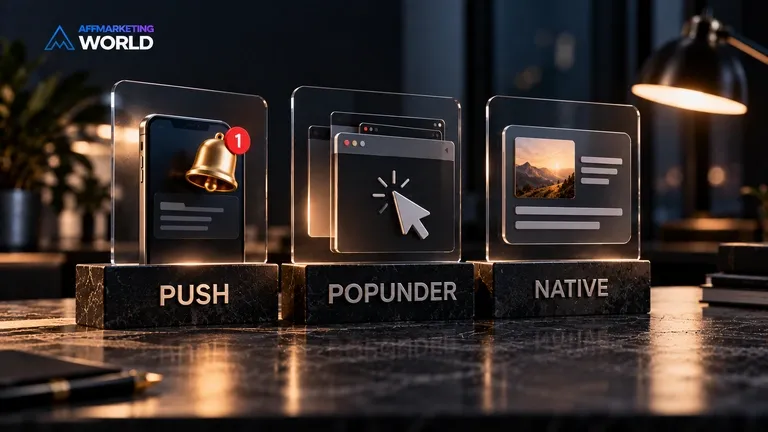
Ask five media buyers which traffic format converts best and you will get five different answers — because the honest answer is "it depends on the vertical," and most of them are only running one or two verticals. Push, popunder, and native pull fundamentally different behaviors out of the same raw traffic pool, and the format that prints money on a nutra offer can lose money outright on a finance lead form.
This is a working map of which format fits which vertical, and why.
What each format actually does to the visitor
Popunder opens a second window or tab behind the one the visitor is already looking at, so they see your offer the moment they close or switch away from the original page. It carries the lowest CPM of the three because it does not interrupt the visitor’s immediate attention — they see it on their own time, often seconds later, sometimes never if they forget the tab exists.
Push notifications land directly on the lock screen or notification tray, completely independent of any website the visitor happens to be on. The network already owns a subscriber base of users who opted into push somewhere on its publisher network, so you are buying access to that list rather than building one. Engagement is immediate and attention-grabbing, but subscriber fatigue is real — the same person can be served offers from a dozen different advertisers in a week.
Native ads are styled to blend into the surrounding editorial content — a "recommended article" widget at the bottom of a news page is the classic example. The format carries an implicit trust signal the other two do not, because the visitor perceives it as content rather than an interruption, which is exactly why it costs more per click.
| Format | Relative cost | Best for | Weak point |
|---|---|---|---|
| Popunder | Lowest | High-volume top-of-funnel testing, gambling and betting offers | Low attention at the moment of impression |
| Push notifications | Low–medium | Nutra, dating, re-engagement of non-converting visitors | Subscriber fatigue, declining CTR over time |
| Native ads | Highest | Finance, Tier-1 gambling, anything needing trust before conversion | Higher CPC, slower volume to scale |
$0.50-$2
Typical popunder CPM, Tier-2/3 GEOs
$1-$4
Typical push CPM, re-engagement campaigns
$0.10-$0.80
Typical native CPC, finance & Tier-1 gambling
3-5x
Native’s cost premium over popunder on a per-click basis
These are industry-typical ranges, not a fixed price list — actual rates shift by network, GEO, device, and how competitive the vertical is that week. Treat them as a sanity check: if a network quotes native CPC close to popunder CPM-equivalent pricing, something about that inventory is probably not real native placement.
GEO breakdown: where each format actually performs
Format performance does not travel evenly across GEOs, because the underlying inventory — the publisher sites and subscriber lists a network draws from — is not evenly distributed either.
| GEO tier | Popunder | Push | Native |
|---|---|---|---|
| Tier-1 (US, UK, DE, CA, AU) | Works, but competitive and pricier than other tiers | Smaller subscriber pools, higher quality per subscriber | Deepest inventory — most premium publisher networks sell native here first |
| Tier-2 (Eastern Europe, LatAm, SEA) | Cheapest, highest raw volume available | Large subscriber bases, moderate fatigue | Growing inventory, still thinner than Tier-1 |
| Tier-3 (South Asia, parts of Africa) | Very cheap, but fraud and bot share rise here | Massive subscriber counts, higher fatigue and lower per-subscriber value | Limited inventory — few premium publishers sell native ad space in these markets yet |
The practical takeaway: a Tier-3 nutra campaign can lean hard on push because the subscriber volume is there and the format’s urgency-driven copy survives repeated exposure. The same budget aimed at a Tier-1 finance offer needs native specifically because Tier-1 audiences are more ad-literate and more likely to dismiss anything that reads as an obvious interruption.
Mobile vs desktop: the same format behaves differently
Device matters almost as much as GEO. Popunder on mobile is constrained by how mobile browsers and OS-level popup blockers handle new windows — networks route around this with mobile-specific redirect flows, but the raw volume and the user experience differ meaningfully from desktop popunder. Push notifications are fundamentally a mobile-native format; the lock-screen behavior that makes push effective barely exists in the same form on desktop, where it is typically a browser-permission prompt most users have learned to dismiss on sight.
Native ads are the most device-agnostic of the three — a recommended-content widget renders comparably on mobile and desktop because it is just styled content, not a system-level interrupt. That consistency is part of why native scales more predictably across a mixed-device audience than push or popunder do.
Matching format to vertical
Gambling and betting traffic typically starts on popunder specifically because of the economics of testing — casino and sportsbook offers need volume to find a winning angle before committing real budget, and popunder CPMs make that testing phase cheap. Once an angle proves out, native often takes over for scaling into Tier-1 GEOs, where the implicit trust of editorial-style placement meaningfully lifts deposit conversion versus a raw popunder.
Nutra and dating lean hardest on push. Both verticals depend on repeat touchpoints and urgency-driven copy — "still interested?" style re-engagement — that fits naturally into a short notification format. PropellerAds, one of the larger networks in this space, specifically flags push as strongest for re-engagement and nutra offers in its own format breakdown.
Finance offers (lending, trading, insurance leads) skew toward native almost by necessity — a visitor is being asked to fill out a form with real financial information, and raw popunder or push traffic converts that ask at a noticeably lower rate than traffic that arrived believing it clicked on editorial content.
E-commerce splits by price point: low-ticket impulse items can perform fine on popunder or push, while higher-ticket purchases benefit from native’s trust signal the same way finance does.
The mistake that quietly burns budget
Running a finance or Tier-1 gambling offer exclusively on the cheapest popunder traffic because the CPM looks attractive on paper. The lower cost per impression does not matter if the conversion rate is low enough that the real cost per acquisition ends up higher than a pricier native placement would have produced.
Networks that run multiple formats from one dashboard
Testing a format split does not require juggling separate accounts. PropellerAds offers Push, Popunder, Interstitial, Direct Click, and SmartLink from a single platform. HilltopAds and Adsterra both support native ads, popunder, and push side by side, which makes it practical to run the same offer across formats and compare real cost-per-acquisition rather than guessing from CPM alone.
Creative specs and moderation: what each format demands
Each format has its own creative requirements and its own moderation choke points — getting these wrong is the most common reason a freshly launched campaign stalls before it ever reaches real optimization.
Popunder
Lightest creative requirements of the three — usually just a landing page URL, since the "ad" is the full page itself rather than a banner. Moderation focuses mainly on the landing page content (no malware, no deceptive claims) rather than on a creative asset, which is part of why this format is fastest to launch.
Push notifications
Needs a short title, a one-line body, and a small icon image — tight character limits force the urgency-driven copy style the format is known for. Networks moderate push harder on misleading claims than popunder does, since the notification itself (not a landing page) is what the user judges first, and complaint rates from annoyed subscribers feed directly into account-level trust scores.
Native ads
The strictest of the three — a headline, image, and short description all styled to match the publisher’s own content, reviewed individually against each publisher’s editorial guidelines in addition to the network’s own policy. Approval is slower, but inventory quality and fraud rates both tend to be better as a direct result of that extra review layer.
- Start cheap to find the angle. Use popunder to test a new offer or landing page before committing serious budget.
- Layer in push for re-engagement once you have traffic that did not convert the first time, especially on nutra or dating offers.
- Move high-trust verticals to native — finance, Tier-1 gambling, anything where the visitor needs to feel safe before converting.
- Track cost per acquisition, not cost per click across formats — the cheapest format on paper is not always the cheapest once conversion rate is factored in.
- Re-test periodically. Push subscriber lists fatigue over months; a format that converted well in one quarter can decay without a creative refresh.
“
The format is not the strategy — the vertical is. Affiliates who treat push, popunder, and native as interchangeable inventory to buy wherever it is cheapest are the ones who cannot explain why the same budget performs differently every month.

Frequently asked questions
1
Which format is cheapest to start with?
Popunder, almost always — CPM rates are the lowest of the three because the ad shows regardless of whether the visitor is paying attention. That makes it the easiest format to test a new gambling or betting offer on without burning much budget before you know if the funnel converts.
2
Why do nutra and dating affiliates lean so heavily on push?
Push notifications reach a subscriber directly on their lock screen, independent of whatever site they are browsing — and nutra/dating offers rely on repeat touchpoints and urgency-driven copy that works well in a short notification format. PropellerAds and similar networks report push performing strongest for exactly these re-engagement-heavy verticals.
3
Is native ads worth the higher cost for gambling traffic?
For Tier-1 gambling and finance offers, often yes. Native ads blend into editorial content and carry an implicit trust signal that raw popunder or push traffic does not, which matters more in verticals where the visitor is about to hand over payment details or deposit money.
4
Can I run all three formats on the same campaign?
Yes, and many affiliates do — popunder for cheap top-of-funnel volume, push for retargeting people who did not convert the first time, and native for the highest-intent segment of traffic. Networks like PropellerAds, HilltopAds, and Adsterra all support multiple formats from one dashboard, so testing a split is low-friction.
5
Does push notification traffic need a subscriber base, or can I start cold?
Ad networks that sell push traffic already own the subscriber base — you are buying access to users who opted into push notifications somewhere on the network's publisher sites, not building your own list from scratch. You can start cold; the network supplies the volume.
6
Which format has the lowest fraud risk?
Native, generally, because it requires a publisher to actually integrate ad units into real editorial pages, which filters out a lot of the low-quality inventory that cheap popunder traffic can carry. That said, fraud risk depends far more on the specific network's anti-fraud tooling than on the format alone.
7
Does the best format change between Tier-1 and Tier-2/3 GEOs?
Yes, meaningfully. Tier-1 audiences are more ad-literate and respond better to native's editorial-style trust signal, while Tier-2/3 markets offer cheaper popunder volume and larger push subscriber pools, which makes those formats more cost-efficient there even for the same offer.
8
Does push work on desktop the same way it works on mobile?
Not really. Push is fundamentally a mobile-native behavior built around the lock screen; on desktop it surfaces as a browser-permission prompt that most users have learned to dismiss on sight, so desktop push volume and engagement both run well below mobile for the same campaign.
Compare ad networks by format and vertical
See which networks support push, popunder, and native, with real traffic policies and payout terms side by side.
Related tags


Sponsored
Share
SUBSCRIBE TO OUR PRIVATE CASES AND USEFUL TIPS
Subscribe to our newsletter, get only exclusive content and weekly digests, no any spam!
By providing my email, I accept the Privacy Policy.