Link copied!
Regulation
The UN puts illegal betting at $1.7 trillion a year — and its center of gravity has shifted to Southeast Asia

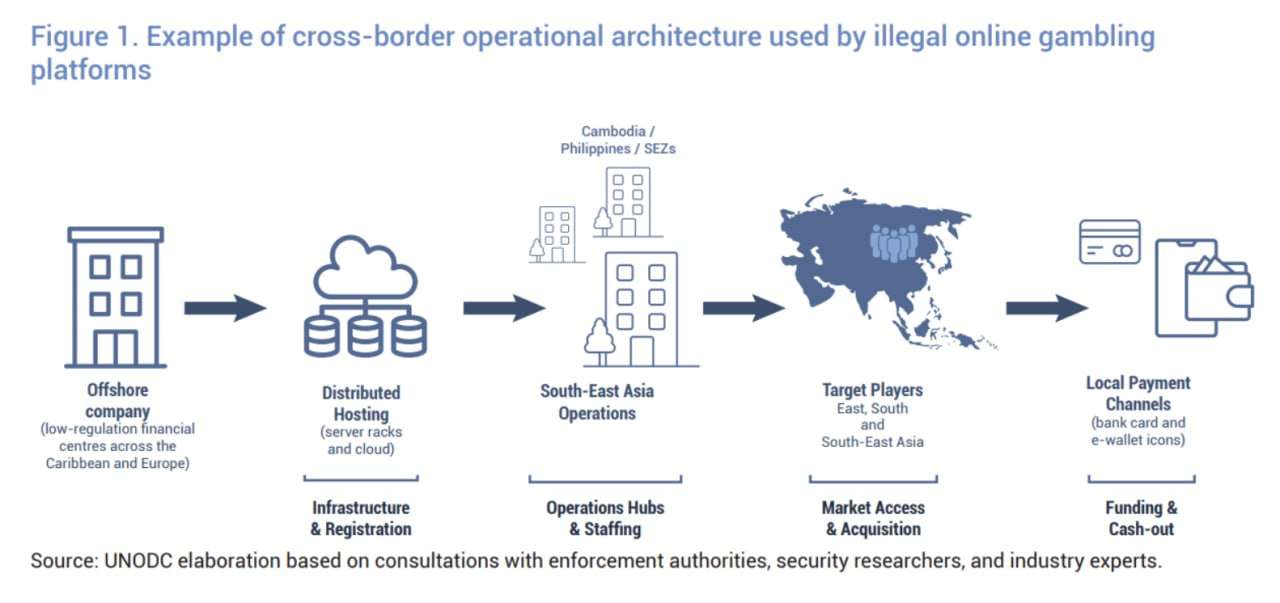
UNODC — the UN body that tracks drugs and organized crime — released a report with a range that is alarming on its own: somewhere between $340 billion and $1.7 trillion in illegal bets moves through the shadow market every year, outside any oversight. A spread that wide usually means one thing — nobody actually knows the real size of the market, which makes it that much harder to fight.
Market scale
The geography tells its own story here: China, Hong Kong, Macau, and Taiwan together account for roughly half of the entire shadow turnover, and the report names these jurisdictions as the base for unlicensed operators’ servers and financial flows.
The way this kind of business gets built looks almost like a kit — the legal entity gets registered wherever the paperwork is easiest, the hardware sits wherever rent is cheap and nobody asks questions, and the money moves through crypto wallets and third-country banks. Spreading a business across three or four jurisdictions is a simple way to make it nearly untouchable for any single regulator.
Examples
The country-level numbers show how deep the problem actually runs. The Philippines had counted nearly 12,000 unlicensed gambling sites by August — more than half of them online casinos, most of the rest cockfighting betting platforms.
Vietnam’s unregulated iGaming market is estimated at $10 billion a year, and this past summer local police took down a single network worth around $840 million, arresting 139 people. In Myanmar, raids on the Shwe Kokko gambling complex turned up nearly 10,000 phones and around 350 detained staff.
Thailand went furthest of all — its investigation into ties with gambling networks has already reached more than two hundred serving police officers.
“
What worries me about this report isn’t the $1.7 trillion figure itself — it’s how systematically it was put together: registration in one country, servers in another, money moving through crypto. This isn’t a chaotic black market anymore, it’s well-built transnational infrastructure.

Related tags




Share
SUBSCRIBE TO OUR PRIVATE CASES AND USEFUL TIPS
Subscribe to our newsletter, get only exclusive content and weekly digests, no any spam!
By providing my email, I accept the Privacy Policy.