Link copied!
Gambling
Fake Tesco casino reported to police, joins Barclays and Monzo scams

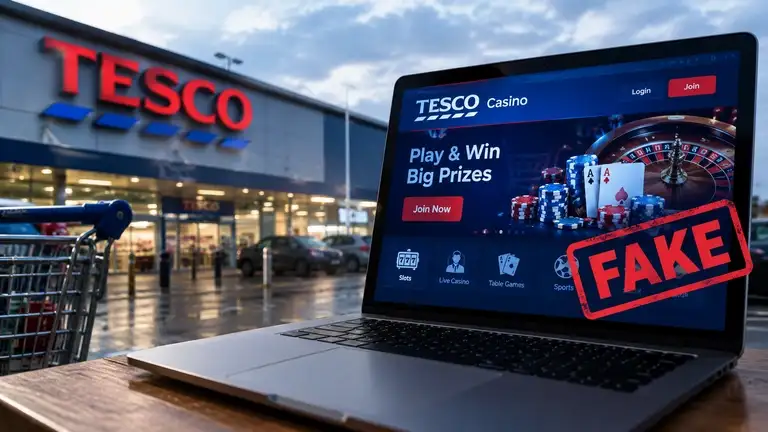
Tesco went to UK police after finding a fake online casino impersonating the supermarket chain and promoted through Facebook ads, joining Barclays and Monzo as recent targets of the same branded gambling-scam pattern.
A fake casino built to look convincing
Tesco went to the police after finding a site pretending to be the supermarket chain’s own online casino, built and promoted through Facebook ads. It carried no UK gambling license and had zero actual connection to Tesco, which is exactly the combination that makes an impersonation scheme like this illegal rather than just tasteless branding.
The site didn’t do a lazy job of it. Whoever built it structured the slot selection to mirror Tesco Extra, the chain’s large-format hypermarket line, and leaned hard on the company’s history in the copy, more than a century in business, as if longevity in the grocery trade somehow vouched for a gambling platform’s legitimacy. Tesco reported the site to the UK’s National Cyber Security Centre and to Report Fraud, the country’s fraud-reporting service. Police confirmed they’d received the report, though as of now it hasn’t been assigned to a specific unit for investigation, leaving the case in a kind of administrative holding pattern.
The same pattern hit Barclays and Monzo first
Tesco isn’t the only recognizable UK brand this has hit. Barclays and Monzo both ran into the same pattern recently. A fake “Barclays Slots” campaign used an image of Formula 1 driver Lewis Hamilton to sell itself, borrowing a face with no connection to either the bank or the gambling site running his likeness. Separate ads promoted an unrelated gambling platform under the Monzo name entirely. Barclays said it has no connection to the campaign and has taken steps to protect both its customers and its intellectual property. Monzo went further, calling the scheme an AI-powered fraud operation outright rather than a vague trademark dispute.
Three well-known UK brands hit with the same tactic inside a short stretch points to something more organized than isolated opportunists. A supermarket, a bank, and a challenger bank each got the identical treatment: borrow the name, borrow the trust that comes with it, and let Facebook’s ad system do the distribution work nobody involved actually paid the real company for. The same structure showed up in Italy not long ago too, where a fake Netflix-branded casino ran the exact same playbook of a recognizable name plus manufactured legitimacy, which suggests this isn’t a UK-specific problem so much as a repeatable template moving between markets.
“
“A supermarket, a bank, and a challenger bank all hit with the identical scam inside weeks of each other isn’t three separate scammers getting lucky, it’s one playbook working well enough to keep reusing.”

Related tags





Share
SUBSCRIBE TO OUR PRIVATE CASES AND USEFUL TIPS
Subscribe to our newsletter, get only exclusive content and weekly digests, no any spam!
By providing my email, I accept the Privacy Policy.