Link copied!
Gambling
South Korea busts 153-site iGaming network worth $197M

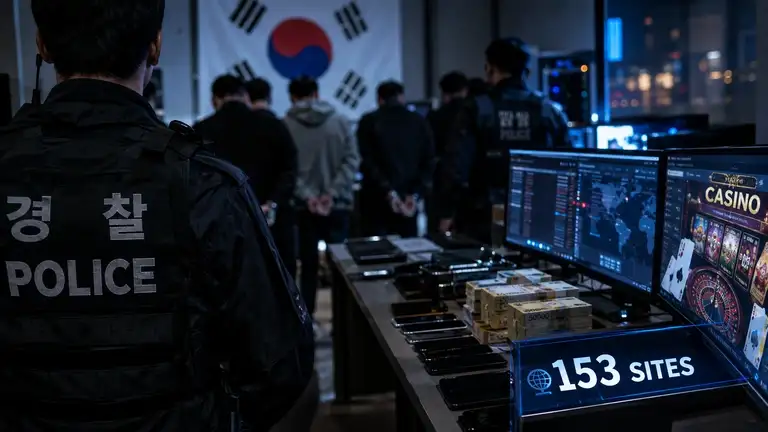
Police in South Korea’s Gyeongsangnam-do province arrested nine people behind a network of 153 unlicensed gambling sites that channeled roughly $197 million in transactions between May 2024 and December 2025.
Nine arrests, two layers of the operation
Police in South Korea’s Gyeongsangnam-do province arrested nine people they say built and ran a network of 153 unlicensed gambling sites aimed at Korean users. Three suspects are being held in custody, while the other six have been handed over to prosecutors, a split that usually signals which roles investigators consider the more central ones in the operation.
Seven of the nine worked at a development company, including its head, and investigators say this group built and administered all 153 sites between June 2023 and April 2026, nearly three years of continuous operation. The system they built pulled in live game streams from gambling platforms based overseas and let Korean users place bets against them directly, effectively wrapping foreign iGaming content in a domestic-facing shell. For building and maintaining the sites, the development company collected roughly 2.2 billion won, about $1.5 million.
Where the real money moved
The other two suspects worked for a separate broker company that sat between the developers and the individual site operators, handing over finished sites and supplying them with in-game currency to actually run on. That broker layer is where the real money moved: between May 2024 and December 2025, it collected around 270 billion won, close to $197 million, from selling game currency and other transactions tied to the network.
The case started from a tip about one employee in December 2025, and investigators worked backward from there, tracing the supply chain of sites and following the money through account records. A court approved a preliminary freeze on about 1 billion won, roughly $730,000, in suspected criminal proceeds based on that account analysis. Access to 22 still-active sites has already been cut off, and two more suspected accomplices who fled the country are now the subject of an international manhunt.
South Korean authorities have taken down networks like this one before, including one built around embedding gambling links inside porn sites, and the pattern across cases keeps landing on the same structure: a small technical team builds and maintains the infrastructure, a separate broker layer handles distribution and currency, and the actual money moves through accounts that only become visible once investigators start pulling threads from a single tip.
“
“The developers made $1.5 million building the plumbing. The brokers made $197 million running currency through it. That gap alone tells you where the actual profit in an illegal gambling network sits.”

Related tags




Share
SUBSCRIBE TO OUR PRIVATE CASES AND USEFUL TIPS
Subscribe to our newsletter, get only exclusive content and weekly digests, no any spam!
By providing my email, I accept the Privacy Policy.