Link copied!
Regulation
Malta’s MGA publishes voluntary AI Gaming Charter for operators

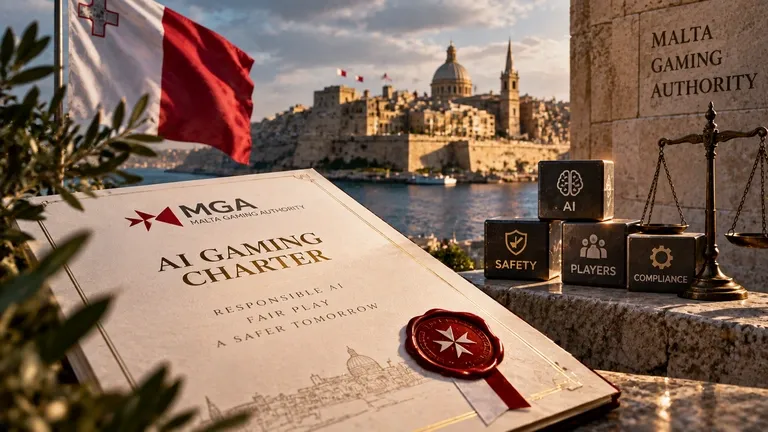
Malta’s Gaming Authority published the AI Gaming Charter, a voluntary set of principles covering every AI system its licensees run, built around five pillars and shaped through direct consultation with the industry.
Applies to every AI system, regardless of risk tier
Malta’s Gaming Authority published the AI Gaming Charter in mid-September, a voluntary set of principles for how licensees should handle artificial intelligence rather than a new legal requirement. The document was built with the Malta Digital Innovation Authority and shaped through sector-wide surveys and direct consultation with licensees, so it reflects what operators themselves flagged as unclear rather than rules written in isolation by the regulator. It doesn’t touch existing EU law on AI or data protection, and MGA has been explicit that adopting it creates no new legal obligations. What it does do is apply to every AI system a licensee runs, regardless of how that system would be classified under the EU AI Act’s own risk tiers.
The charter is built around five pillars: transparency, data governance, human oversight, non-discrimination, and stakeholder engagement. In practice, that translates into a short list of concrete asks. Licensees are encouraged to keep an inventory of every AI system they use, tracking its purpose, ownership, risk classification, deployment context, and where it sits in its lifecycle. They’re also asked to conduct AI impact assessments looking at how a given system could affect individuals, groups, or society more broadly, and to set up some form of internal oversight, whether that’s a dedicated ethics committee or simply naming a senior person responsible for AI governance day to day.
A point of contact, not a new department
On staffing specifically, the charter recommends designating one or more responsible individuals from compliance, data, technology, or AI-related functions to act as an internal point of contact for anything tied to the charter. That’s a deliberately flexible instruction. It doesn’t mandate a new role or department, just someone inside the organization who can answer for how AI gets used there.
MGA CEO Charles Mizzi framed the whole effort in terms of certainty rather than restriction: “Our role as a regulator is not to stand in the way of innovation, but to help create certainty and confidence for responsible innovation.” That’s a fairly standard line for a voluntary framework, but it does capture the actual bet here. Malta isn’t trying to regulate AI in gambling through hard rules yet. It’s trying to get ahead of the EU AI Act’s own compliance deadlines by giving licensees a template to work from now, before something stricter eventually replaces it. The timing fits Malta’s usual posture as an iGaming hub eager to stay accommodating, the same instinct that had its own prime minister vowing to block an EU-wide gambling tax proposal just days earlier.
“
“A voluntary charter with no legal teeth is still a signal — Malta would rather hand operators a template now than wait for Brussels to hand them a mandate later.”

Related tags




Share
SUBSCRIBE TO OUR PRIVATE CASES AND USEFUL TIPS
Subscribe to our newsletter, get only exclusive content and weekly digests, no any spam!
By providing my email, I accept the Privacy Policy.