Link copied!
Betting
Kalshi’s volume is now 2.7x Polymarket’s, and sports is why

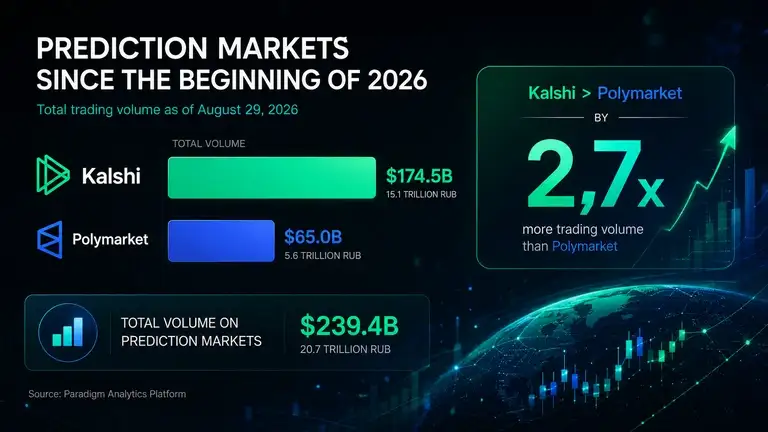
Kalshi has pulled dramatically ahead of Polymarket in trading volume since the start of 2026, and the numbers behind the gap show the two platforms have quietly built very different businesses.
The $109.6 billion gap
Paradigm, the analytics platform that tracks prediction-market activity, put Kalshi’s year-to-date volume at $174.5 billion as of August 29. Polymarket sat at $64.9 billion over the same stretch. Do the math and Kalshi has moved roughly 2.7 times more money, a $109.6 billion gap between the two platforms that have spent most of this year positioned as direct rivals for the same trader base.
Sports carry most of Kalshi’s number, and combined bets specifically make up the largest single slice of that sports volume — the same parlay-style mechanic Polymarket has only recently started testing on its own US product. Basketball leads among individual sports, with tennis, football, and baseball trailing behind it in that order. Crypto markets pull a real chunk of volume too, though nowhere close to sports. Political markets, despite being the category most people associate with prediction markets in the first place, account for a comparatively small piece of what’s actually moving through Kalshi. Another $19.8 billion sits outside any of these categories entirely, unclassified in Paradigm’s breakdown.
Two platforms, two different businesses
Polymarket’s numbers tell a different story about where its volume actually comes from. Sports still matter there — betting on the 2026 World Cup winner alone cleared $4 billion on the platform — but political events and crypto pull meaningfully more weight in Polymarket’s mix than they do in Kalshi’s, where sports has clearly become the dominant category by a wide margin. Polymarket has its own unclassified bucket too, $24.7 billion worth, proportionally similar in size to Kalshi’s.
What the numbers suggest is that these two platforms, often talked about as interchangeable competitors chasing the same market, have actually built different businesses under the same “prediction market” label. Kalshi looks increasingly like a sports-betting platform that happens to settle contracts the way an exchange does. Polymarket still leans toward the broader forecasting use case its early reputation was built on — politics, crypto, world events, with sports as one category among several rather than the engine driving the whole platform. A 2.7x gap in raw volume matters less on its own than what’s actually generating it, and right now that’s two platforms pulling in noticeably different directions.
“
“Call Kalshi a prediction market if you want, but with basketball parlays carrying most of the volume, it’s a sportsbook that files its paperwork with the CFTC instead of a state gaming commission.”

Related tags





Share
SUBSCRIBE TO OUR PRIVATE CASES AND USEFUL TIPS
Subscribe to our newsletter, get only exclusive content and weekly digests, no any spam!
By providing my email, I accept the Privacy Policy.