Link copied!
AI
Google releases Gemini 4 Argon, its new flagship for long, complex tasks

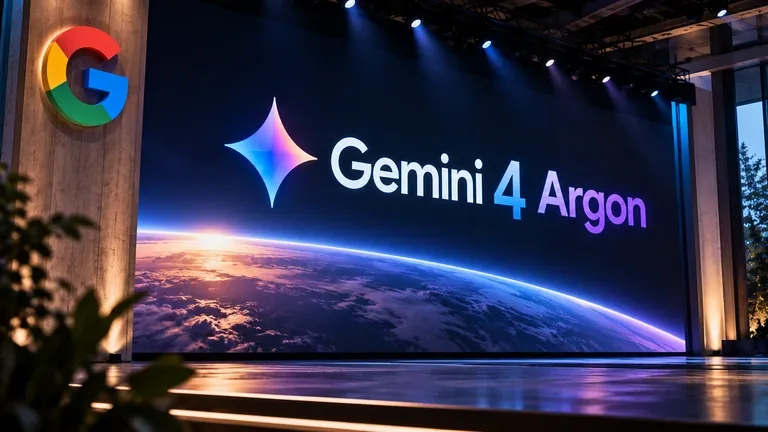
Google quietly released Gemini 4 Argon, a new flagship model built for long and complex tasks, with an output limit sixteen times larger than its predecessor and new highs on multiple coding benchmarks.
A sixteen-fold jump in output, and new benchmark highs
Google released Gemini 4 Argon without much warning, positioning it as the new flagship for long, complicated tasks rather than quick chat responses. The headline number is the output limit: Argon can generate up to 1 million tokens in a single run, a sixteen-fold jump from the 64,000-token ceiling on its predecessor. According to Google’s own announcement, that expanded limit is paired with real gains in capability rather than just a bigger buffer, the model posted 77.9% on DeepSWE v1.1 and 91.9% on Vibe Code Bench, both new highs among frontier models, with the Vibe Code result edging out GPT-6 Astra and both current Claude models by a narrow but real margin.
Google is testing it on its own codebase first
Google isn’t just shipping Argon externally, it’s using it internally first. Argon agents are already working through Google’s own C and C++ codebases, rewriting them in Rust, with one migration reaching the Fuchsia Zircon kernel at more than 800,000 lines of code. That’s the kind of unglamorous, high-stakes engineering work companies usually hand to senior staff rather than an AI agent, and Google is treating the model’s performance there as a credibility marker as much as a product feature. One optimization an Argon-assisted team found freed over 300 TiB of memory across Google’s data centers once it rolled out, with the company estimating 500 TiB to a full petabyte in savings once it’s applied more broadly, a number large enough to matter at hyperscale even before counting the compute cost of running the model itself.
Pricing starts at $2 per million input tokens and $10 per million output tokens, introductory rates that Google has already said will double to $4 and $20 once the launch window closes. That’s a candid way to price a new model, most companies let introductory pricing quietly expire rather than publishing the increase in advance. Access is narrow for now: Argon is rolling out first to cybersecurity researchers through Google’s Fairwind Program, with developers, enterprises, and everyday users told to expect access later rather than immediately. For a model built around long, complex tasks rather than quick answers, gating the rollout to the people most likely to stress-test it with exactly that kind of work is a reasonable way to find problems before a wider release.
“
“Publishing the exact date your price doubles isn’t generosity, it’s just honesty about what introductory pricing always was.”

Related tags




Share
SUBSCRIBE TO OUR PRIVATE CASES AND USEFUL TIPS
Subscribe to our newsletter, get only exclusive content and weekly digests, no any spam!
By providing my email, I accept the Privacy Policy.