Link copied!
AI
Memora gives Codex and Claude Code persistent memory between sessions

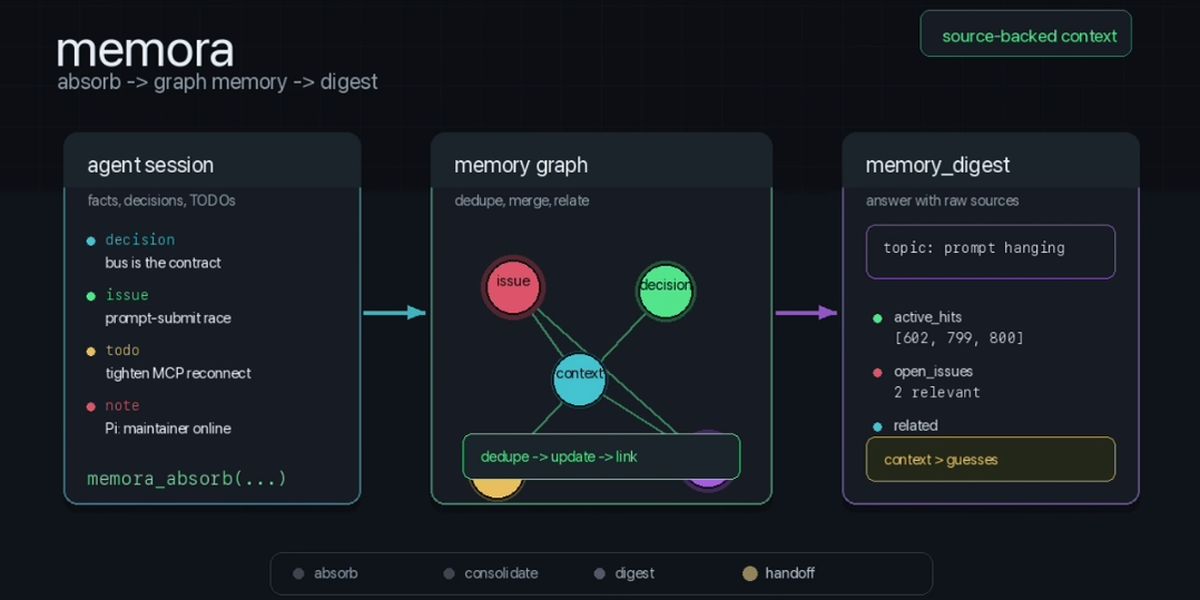
A new open-source tool called Memora gives AI coding agents like Codex and Claude Code memory that survives between sessions, instead of starting from zero every time a chat window closes.
How Memora’s memory_digest function works
Ask Memora about a topic and a single function, memory_digest, hands back everything relevant in one shot: past context on the subject, TODOs still sitting open, related facts pulled from prior sessions, and the original sources those facts came from. That’s the mechanism actually doing the work behind “the agent remembers,” a structured lookup, not the model somehow holding onto more tokens between sessions on its own.
Storage defaults to a local SQLite file sitting on disk, though Memora also syncs through Cloudflare D1, S3, or Cloudflare R2 for anyone running agents across multiple machines, with optional encryption and compression available on the cloud-synced versions. Finding the right memory relies on semantic search, configurable between TF-IDF, sentence-transformer models, or OpenAI embeddings depending on what’s already available in the setup, plus hybrid queries that combine full-text search with date ranges and tag filters.
Memora’s knowledge graph and RAG chat interface
Every stored memory, TODO, and document becomes a node in an interactive graph, viewable through a built-in local server running on port 8765 that updates live as the agent writes new memories during a session. Nodes get color-coded by type, so tags, issues, and TODOs are visually distinct at a glance without opening a single file to check, and a cloud-hosted version of the same graph is available through Cloudflare Pages for remote access.
A chat panel built into that same interface lets anyone query the memory store directly in natural language, with RAG-powered responses citing which stored memory backed each answer and streaming back clickable references as the answer comes in. The same chat can create, update, or delete memories on command, turning what would normally require editing a database directly into an ordinary conversation instead.
“
Giving an agent a queryable graph instead of a longer context window is a different bet on what “memory” should mean for these tools: a structure built to outlast the session itself, independent of how much context any single conversation can hold.

Related tags




Share
SUBSCRIBE TO OUR PRIVATE CASES AND USEFUL TIPS
Subscribe to our newsletter, get only exclusive content and weekly digests, no any spam!
By providing my email, I accept the Privacy Policy.