Link copied!
AI
Open-source book-to-skill converter turns any book into an AI agent skill

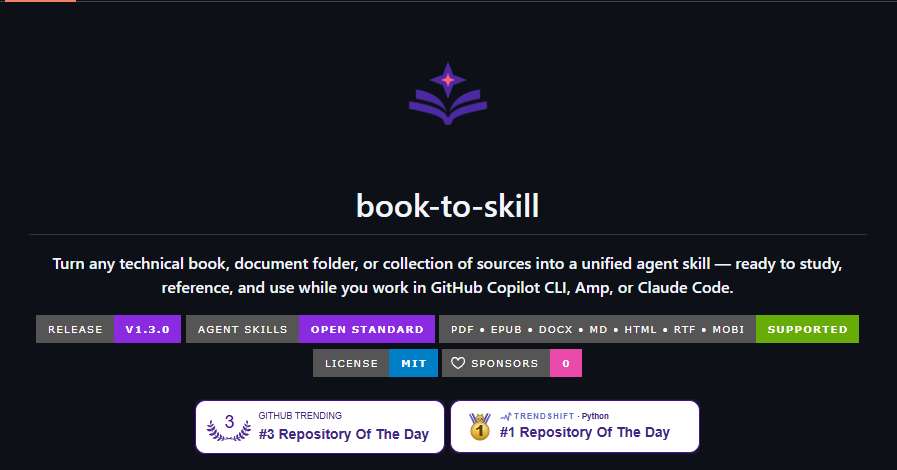
A new open-source tool called book-to-skill turns any PDF, EPUB, DOCX, or folder of documents into a structured skill an AI agent can query on demand, instead of loading the whole book into its context window every time.
How it cuts token costs
The tool’s core claim is a 24x to 51x reduction in tokens compared with pasting a full book into a chat, achieved by paying the structuring cost once at conversion time instead of over and over with every query. That repeated cost has a name in the project’s own docs: the “discovery loop tax,” the tokens an agent burns re-fetching a table of contents or backtracking through a document it’s already partly read every time a new question comes up.
A converted book turns into five separate files: a SKILL.md core file around 4,000 tokens covering mental models and a chapter index, individual chapter files near 1,000 tokens each that only load when needed, a glossary of roughly 1,500 tokens, a pattern list near 2,000 tokens, and a cheatsheet around 1,000 tokens. The agent pulls in whichever piece answers the question at hand instead of holding the entire text in memory for every exchange, joining a small but growing set of open-source tools built specifically around cutting Claude’s token costs.
What it handles, and where it fits
Input formats cover PDF, EPUB, DOCX, Markdown, HTML, RTF, and MOBI, with fallback extraction methods built in for each one, and the tool works against a single file or a whole folder of documents at once, useful for turning an entire reference library into one queryable skill. Everything happens locally, nothing gets uploaded anywhere, and it installs the same way most agent skills do, cloned straight into the Claude Code skills directory.
It’s built to plug into Claude Code, GitHub Copilot CLI, and Amp specifically instead of running as a standalone app, following the same skills-folder convention those tools already use for extending an agent’s capabilities. The code and skill definition ship under an MIT license, though the project draws a clear line: that license covers the converter itself, and the output is meant to function as personal study notes for material the user already has rights to, without becoming a redistributable copy of the source.
“
A tool built around cutting an agent’s own token overhead is a quieter kind of release than most that get attention right now, but it’s solving a real problem — the gap between an agent that can genuinely reference a 400-page manual and one that just pretends to after skimming the first chapter.

Related tags




Share
SUBSCRIBE TO OUR PRIVATE CASES AND USEFUL TIPS
Subscribe to our newsletter, get only exclusive content and weekly digests, no any spam!
By providing my email, I accept the Privacy Policy.